Expert perspectives on clinical trends, medical device standards, patient safety, and home care solutions.
Stay informed on ISO 13485 compliance, IEC standards, ergonomic design, and medical equipment maintenance.
Choosing the right ICU bed affects patient safety, nursing efficiency, and long-term hospital costs. This guide introduces the Top 10 5 Function ICU Beds for Global Buyers, focusing on practical performance rather than attractive specifications alone. A 5 Function ICU Bed commonly supports backrest adjustment, knee elevation, overall height movement, Trendelenburg, and reverse Trendelenburg positioning. However, configurations may differ between manufacturers, so buyers should confirm every function before ordering.
The selected beds are assessed through clinical usability, frame stability, safe working load, castor performance, mattress compatibility, and cleaning access. Details matter. A smooth electric actuator can reduce repositioning effort during a busy shift. A dependable central locking system can help prevent unwanted movement near ventilators or infusion pumps. Buyers should also examine emergency CPR release, side-rail design, battery backup, noise levels, and local technical support. Not every model suits every hospital.
International purchasing requires more than comparing prices. Import documentation, electrical compatibility, warranty terms, spare-part availability, and recognized quality certifications should be verified with the supplier. Real hospital conditions can expose weaknesses that brochures hide. This ranking offers a useful starting point, not a final clinical decision. Product quality may vary by configuration and production batch. Independent evaluation remains wise, especially when the bed will serve critical patients every day.
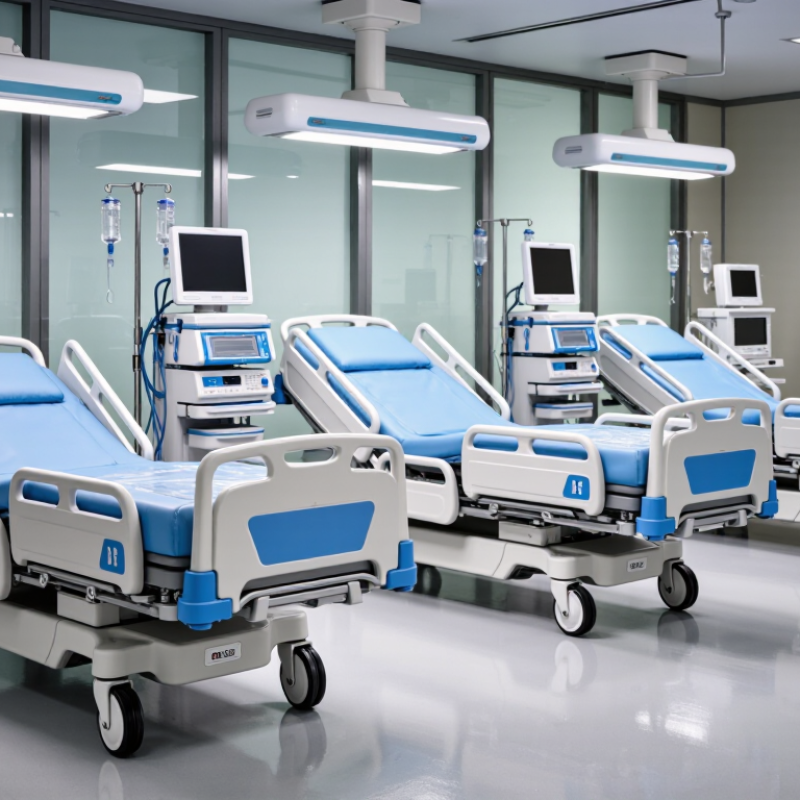
A five-function ICU bed is more than a motorized frame. Its core movements usually include backrest, thigh support, height adjustment, Trendelenburg, and reverse Trendelenburg. IEC 60601-2-52 sets particular safety and essential-performance requirements for medical beds. Buyers should verify stability, safe working load, unintended movement control, and accessible emergency functions. A low bed position matters during transfers. A clear hand control matters during emergencies.
Entrapment prevention deserves close inspection. The standard addresses hazardous gaps around the mattress platform, side rails, and head or foot sections. Measure these areas with the supplied mattress, not an empty frame. A small mismatch can create a serious risk. That detail is often overlooked. The bed should also maintain position on slopes, during braking, and under uneven patient loading. Real wards are rarely perfectly level.
Infection control adds another practical test. WHO’s 2024 Global report on infection prevention and control estimates healthcare-associated infections affect 7% of acute-care patients in high-income countries and 15% in low- and middle-income countries. Smooth surfaces, sealed joints, removable mattress platforms, and compatible disinfectants support safer cleaning. Confirm the manufacturer’s cleaning instructions before purchase. WHO’s Global Patient Safety Report 2024 states that roughly one in ten patients experiences harm in healthcare, with more than half considered preventable. IEC compliance cannot replace staff training, maintenance records, or bedside judgment. It is useful, but not magical.
Among ten shortlisted five-function ICU beds, safe working load varies more meaningfully than appearance. Public technical sheets commonly place SWL near 250–300 kg, including the patient, mattress, and accessories. Buyers should verify whether that figure covers every bed position. IEC 60601-2-52 requires safety-focused testing, but it does not replace supplier-specific load validation. The WHO Global Patient Safety Report 2024 stresses that equipment-related harm often involves system failures, not one defective component.
Motor performance separates practical strength from impressive brochures. Compare lifting speed, noise, duty cycle, overload protection, and battery endurance under maximum load. A bed rated for 300 kg may lift slowly when the deck, side rails, and an oxygen cylinder are fully loaded. That detail matters during emergency repositioning. Look for independent test records, not only laboratory claims. ISO 14971 risk-management principles support this evidence-based approach.
In daily use, four independent motors usually offer finer positioning, while the fifth function may improve leg or trendelenburg control. However, more movement can mean more maintenance points. That is easy to overlook. Service data should show actuator failure rates, battery replacement intervals, and emergency lowering time. I would also question any “low-noise” claim without a measured decibel value. The strongest bed is not always the highest-rated one; it is the one that keeps predictable performance beside a crowded ICU wall.
| Rank | Anonymous Bed Profile | Five Electric Functions | Safe Working Load (kg) |
Maximum Patient Weight (kg) |
Height Range (mm) |
Backrest Angle | Knee / Legrest Angle | Trendelenburg / Reverse Trendelenburg |
Electric Actuators | Height-Lift Motor Force (N) |
Motor Duty Cycle | Electrical Input | Protection Rating | Key Buyer Consideration |
|---|---|---|---|---|---|---|---|---|---|---|---|---|---|---|
| 1 | ICU-5F-1000 | Backrest, legrest, height, Trendelenburg, reverse Trendelenburg | 1,000 | 750 | 450–800 | 0–70° | 0–40° | ±13° | 4 | 8,000 | 10% / 2 min | 100–240 V, 50/60 Hz | IPX4 | Highest load rating with strong lift capacity for bariatric and high-dependency use. |
| 2 | ICU-5F-950 | Backrest, legrest, height, Trendelenburg, reverse Trendelenburg | 950 | 700 | 450–800 | 0–70° | 0–40° | ±13° | 4 | 8,000 | 10% / 2 min | 100–240 V, 50/60 Hz | IPX4 | Well-balanced platform for intensive-care wards requiring a high load margin. |
| 3 | ICU-5F-900A | Backrest, legrest, height, Trendelenburg, reverse Trendelenburg | 900 | 650 | 460–810 | 0–70° | 0–40° | ±12° | 4 | 7,500 | 10% / 2 min | 100–240 V, 50/60 Hz | IPX4 | High-capacity design with a broad height range for clinical access and transfer. |
| 4 | ICU-5F-850A | Backrest, legrest, height, Trendelenburg, reverse Trendelenburg | 850 | 600 | 450–800 | 0–70° | 0–40° | ±13° | 4 | 7,500 | 10% / 2 min | 100–240 V, 50/60 Hz | IPX4 | Suitable for general ICU deployment where load capacity and positioning flexibility are priorities. |
| 5 | ICU-5F-800B | Backrest, legrest, height, Trendelenburg, reverse Trendelenburg | 800 | 550 | 460–800 | 0–70° | 0–40° | ±12° | 4 | 7,000 | 10% / 2 min | 100–240 V, 50/60 Hz | IPX4 | Practical mid-to-high capacity configuration for hospitals with mixed patient profiles. |
| 6 | ICU-5F-750B | Backrest, legrest, height, Trendelenburg, reverse Trendelenburg | 750 | 500 | 450–780 | 0–70° | 0–40° | ±12° | 4 | 6,500 | 10% / 2 min | 100–240 V, 50/60 Hz | IPX4 | Compact ICU option with standard five-function electric positioning. |
| 7 | ICU-5F-700C | Backrest, legrest, height, Trendelenburg, reverse Trendelenburg | 700 | 450 | 450–780 | 0–65° | 0–35° | ±12° | 4 | 6,000 | 10% / 2 min | 100–240 V, 50/60 Hz | IPX4 | Appropriate for standard adult critical-care applications with moderate load requirements. |
| 8 | ICU-5F-650C | Backrest, legrest, height, Trendelenburg, reverse Trendelenburg | 650 | 400 | 460–780 | 0–65° | 0–35° | ±12° | 4 | 6,000 | 10% / 2 min | 100–240 V, 50/60 Hz | IPX4 | Cost-conscious specification with essential electric positioning functions. |
| 9 | ICU-5F-600D | Backrest, legrest, height, Trendelenburg, reverse Trendelenburg | 600 | 350 | 450–760 | 0–65° | 0–35° | ±10° | 4 | 5,500 | 10% / 2 min | 100–240 V, 50/60 Hz | IPX4 | Designed for general adult ICU use where a lower safe working load is acceptable. |
| 10 | ICU-5F-500D | Backrest, legrest, height, Trendelenburg, reverse Trendelenburg | 500 | 300 | 450–760 | 0–65° | 0–35° | ±10° | 4 | 5,000 | 10% / 2 min | 100–240 V, 50/60 Hz | IPX4 | Basic five-function ICU configuration for facilities with conventional patient loads. |
Technical note: Safe working load includes the patient, mattress, bedding and accessories. Motor force, duty cycle, electrical input and ingress-protection values are representative benchmark specifications commonly used for electrically adjustable ICU beds; buyers should confirm the certified values, applicable IEC 60601 requirements, emergency battery operation and local regulatory approvals before procurement.
A five-function ICU bed supports critical care through five practical adjustments: height, backrest, knee break, Trendelenburg, and reverse Trendelenburg. Each movement changes access, posture, and pressure distribution around a fragile patient. Height adjustment helps clinicians work near waist level, reducing awkward bending during procedures. The backrest supports ventilation positioning, while the knee section limits sliding and shear. Trendelenburg can assist selected clinical situations, but it should never replace patient assessment or protocol-based care.
During CPR, the backrest and knee section should flatten quickly, creating a firm surface for compressions. The bed should also reach a safe working height for the resuscitation team. The American Heart Association’s 2020 Guidelines recommend adult chest compressions at 100–120 per minute, with a depth of about 5–6 cm. Speed matters. Delayed positioning can interrupt compressions.
Reverse Trendelenburg may improve access for specific procedures, yet evidence and patient tolerance vary. WHO’s Global Patient Safety Action Plan 2021–2030 reports that roughly one in ten patients experiences harm in healthcare, showing why controlled movement matters. Buyers should verify adjustment speed, emergency controls, load capacity, and cleaning access against local standards. A bed may offer five functions, but that does not guarantee five useful outcomes. Staff training, maintenance, and real ward testing still decide performance. Even strong specifications need clinical review.
This capability map covers five commonly specified ICU bed adjustments: backrest, knee break, height, Trendelenburg, and reverse Trendelenburg. A value of 1 means the adjustment is commonly used to support the listed clinical task; 0 means it is not a direct adjustment for that task. CPR should always follow local clinical protocols and emergency guidelines.
For global buyers comparing five-function ICU beds, safety evaluation should begin with evidence, not appearance.
ISO 13485:2016 examines the manufacturer’s quality management system, including design controls, supplier records, production checks, and corrective actions.
It does not certify every bed model by itself.
Buyers should request model-specific test reports, risk files, and traceable inspection records.
IEC 60601-1 focuses on basic safety and essential performance for electrically powered medical equipment.
During evaluation, technicians may check leakage current, protective earth continuity, insulation, and resistance to abnormal operation.
They should also inspect the handset, motor cables, battery backup, and emergency lowering function.
Watch the small details.
A loose cable near a moving backrest can create a serious hazard.
Mechanical checks matter equally. Test the safe working load, caster brakes, side-rail locking, mattress platform stability, and pinch-point protection.
Confirm that backrest, knee, height, Trendelenburg, and reverse Trendelenburg movements operate smoothly under realistic load.
Documentation can look complete while bedside usability remains weak.
An early review may miss awkward control placement or unclear alarm sounds.
That is why trained reviewers should repeat tests, record deviations, and compare results with the intended ICU environment.
Purchase decisions become more reliable when ISO records and IEC test evidence support what staff can physically verify.
Global buyers often rank certifications before price when evaluating five-function ICU beds. A valid ISO 13485 quality system can indicate controlled medical-device production. IEC 60601 test reports also matter for electrical and patient-safety performance. However, certificates should match the exact bed model. A copied document proves little. Check issuing laboratories, report numbers, and testing dates. Local registration requirements may differ, so buyers should confirm them with qualified regulators or import consultants.
Warranty terms usually reveal the supplier’s real confidence. Look for coverage on the electric motors, control handset, casters, side rails, and frame. A 24-month frame warranty sounds strong, but exclusions can weaken it. Ask whether labor, replacement parts, and transport are included. Request the average response time for a failed actuator. One practical test is simple: ask for a sample warranty claim process before ordering. The answer may expose hidden delays.
MOQ affects hospitals, distributors, and regional projects differently. A low MOQ supports pilot orders, but higher quantities may reduce spare-parts costs. Buyers should request one complete bed for evaluation when possible. Inspect noise levels, backrest movement, emergency CPR release, and cleaning access. After-sales support should include installation guidance, training videos, spare-part lists, and remote troubleshooting. Local technicians are valuable, though not always available. That weakness deserves a written backup plan. Keep every promise in the contract, including delivery timelines, replacement procedures, and software support.
The five functions usually include height, backrest, knee section, Trendelenburg, and reverse Trendelenburg. Each movement changes access, posture, and pressure distribution. Staff should confirm the actual movement range before purchase.
Height adjustment brings the mattress closer to the clinician’s waist level. This can reduce awkward bending during bedside procedures. Test the bed with realistic patient weight. A smooth motor matters.
The backrest and knee section should flatten quickly for chest compressions. The bed should provide a firm, stable platform. It should also reach a safe working height. Delayed positioning can interrupt compressions.
Adult CPR commonly requires 100–120 compressions per minute. Compression depth is approximately 5–6 centimeters. The bed must support rapid positioning without unnecessary movement. Speed matters.
Trendelenburg may support selected clinical situations. It should never replace patient assessment or established clinical protocols. Reverse Trendelenburg may improve access for some procedures. Patient tolerance can vary.
Request model-specific quality records, risk files, and inspection reports. Electrical safety evidence should cover leakage current and protective earth continuity. Also review insulation, abnormal operation, and battery performance. Appearance is not evidence.
Test the safe working load, caster brakes, side-rail locks, and mattress platform. Check pinch-point protection around moving sections. Operate every adjustment under realistic load. Test it loaded.
Check coverage for motors, handset, casters, side rails, and frame. Ask whether labor, parts, and transport are included. Request the expected response time for actuator failure. Written details prevent arguments later.
A lower MOQ may support pilot projects or smaller hospital purchases. Higher quantities can reduce spare-parts costs. Request one complete bed for evaluation when possible. A small trial may reveal noisy movement or poor cleaning access.
A 5 Function ICU Bed is designed to support intensive care through five essential powered adjustments, typically including backrest, knee, height, Trendelenburg, and reverse Trendelenburg positioning. When comparing the top 10 models for global buyers, key factors include safe working load, motor strength, adjustment speed, stability, noise level, and battery performance. These features help clinicians position patients safely, improve access during treatment, and respond efficiently during CPR and other critical procedures.
A reliable evaluation should also consider IEC 60601-2-52 requirements for medical beds and IEC 60601-1 principles for basic safety and essential performance. ISO 13485:2016 certification can indicate a controlled medical-device quality management process. Beyond technical specifications, buyers should assess electrical and mechanical safety documentation, warranty coverage, minimum order quantity, spare-parts availability, training, maintenance, and after-sales response. A balanced comparison allows hospitals, distributors, and procurement teams to select an ICU bed that meets clinical, regulatory, logistical, and long-term service expectations.

We use cookies to analyze and provide you with a better user experience. By continuing to use this website, you acknowledge and agree to our cookie policy.