1. Executive Overview: The Vital Role of Patient Transfer Stretchers in Modern Clinical Workflows
In acute care, emergency medicine, and perioperative nursing, the Hospital Patient Transfer Stretcher serves as the primary mobile interface between triage, imaging, surgical suites, and intensive care units (ICUs). Often referred to as emergency transfer trolleys or hydraulic transport stretchers, these medical devices are far more than passive transport platforms; they are active critical-care management tools designed to preserve patient stability, protect caregiver ergonomics, and streamline hospital operational throughput.
According to healthcare ergonomics studies, over 40% of nursing staff back injuries occur during manual patient repositioning and transfer between beds, stretchers, and diagnostic tables. Furthermore, adverse patient events—such as accidental line dislodgement, pressure ulcer exacerbation, and patient falls during intra-hospital transit—represent substantial financial liabilities and clinical risks for healthcare organizations worldwide. Selecting an appropriately engineered hospital patient transfer stretcher directly mitigates these operational hazards.
This technical guide evaluates the engineering parameters, safety standards, future market trajectories, and procurement strategies essential for hospital purchasing committees, medical equipment importers, and healthcare facility planners evaluating patient transfer equipment.
2. Core Engineering Innovations and Technical Trends in Transfer Stretchers
Modern hospital patient transfer stretchers have evolved rapidly due to advances in metallurgy, hydraulic fluid dynamics, radiolucent polymer composites, and human factors engineering. When specifying transfer stretchers for modern hospital wards and emergency departments, biomedical engineering teams focus on several key structural innovations:
2.1 Advanced 5th Wheel Directional Steering Systems
Navigating crowded hospital corridors, tight elevator doors, and acute care wards requires exceptional maneuverability. Traditional four-swivel castor stretchers require substantial physical exertion from two caregivers to maintain straight-line tracking. Modern high-end stretchers, such as the Joson-Care JE-200 Hydraulic Emergency Stretcher, feature a retractable 5th wheel steering mechanism located beneath the center of mass.
When engaged, the 5th wheel creates a central pivot axis, reducing initial pushing force by up to 60% and enabling a single caregiver to guide the stretcher through tight 90-degree corridor turns without lateral drift or physical strain. Upon reaching the patient bed, the 5th wheel retracts seamlessly, enabling 360-degree lateral positioning for zero-gap patient transfers.
2.2 Hydraulic Dual-Pedal Height & Position Controls
Speed and reliability are paramount during emergency resuscitations and rapid trauma transfers. Manual crank systems are increasingly obsolete in emergency settings due to slower response times and physical fatigue. Dual-side hydraulic foot pedal systems allow clinicians to adjust mattress height, Trendelenburg, and Reverse Trendelenburg positions hands-free, keeping their hands on the patient or airway equipment.
High-grade hydraulic cylinders provide smooth, controlled descent and ascent, preventing sudden mechanical jerks that could cause pain or spinal misalignment in trauma victims.
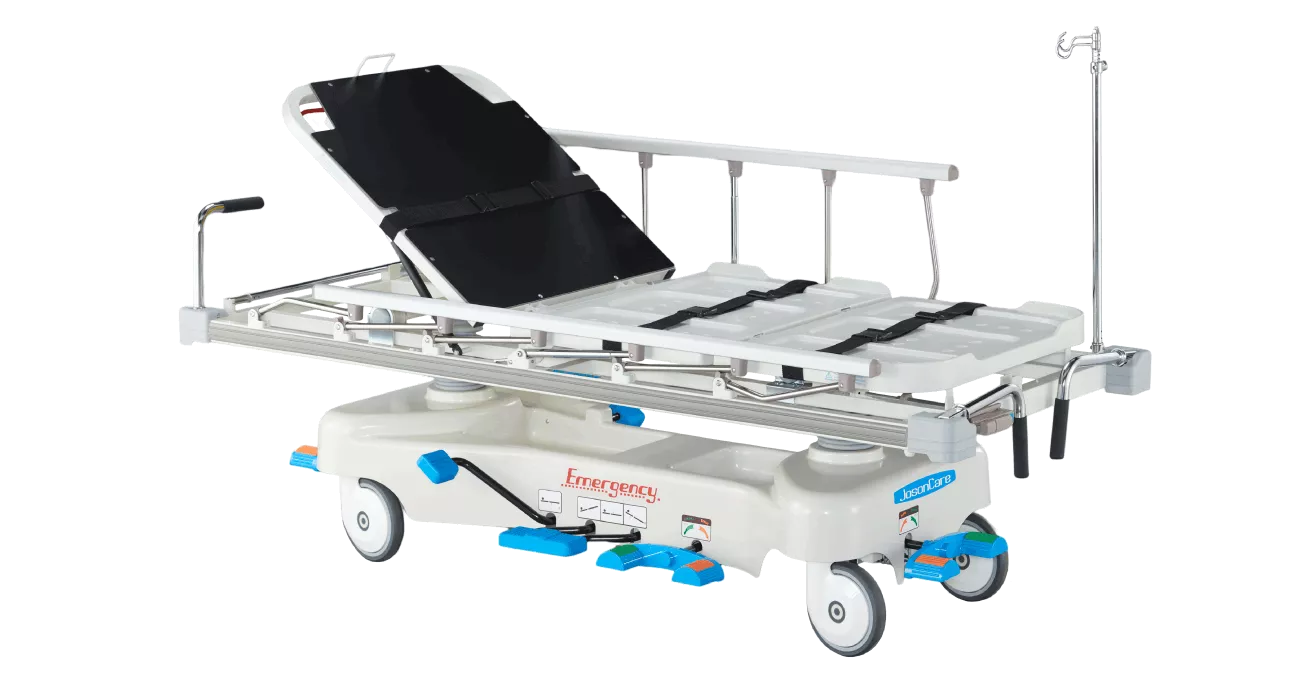
2.3 Radiolucent Platforms & Integrated C-Arm / X-Ray Compatibility
In emergency and trauma care, transferring a unstable patient from a stretcher to a fixed X-ray or CT table increases the risk of cervical spine compression and hemodynamic collapse. Next-generation hospital patient transfer stretchers feature full-length radiolucent backrests or complete HPL (High-Pressure Laminate) radio-transparent bed decks.
Integrated slide-in cassette holders beneath the backrest allow radiographers to insert X-ray plates directly beneath the patient. This enables immediate thoracic, abdominal, or pelvic radiography without repositioning the patient, dramatically reducing door-to-treatment times in acute stroke and trauma protocols.
2.4 Full-Coverage Collapse Side Rails with Zero-Gap Transfer Capability
Patient safety guidelines demand side rails that prevent accidental falls during fast transport while maintaining zero clearance during lateral transfer to an operating table or hospital bed. Modern side rail designs collapse vertically or rotate flush beneath the mattress frame, eliminating gaps where catheters, IV lines, or patient limbs could become pinched during transfer.
3. Recommended Product Solutions: Joson-Care Transfer & Care Series
Joson-Care Enterprise Co., Ltd. manufactures a wide line of clinical transfer stretchers and specialized medical beds engineered to meet rigid international safety guidelines including IEC 60601-1, IEC 60601-2-52, and ISO 13485 quality standards. Below are our flagship offerings for critical care and patient transfer applications:
| Model / Series | Primary Application | Elevation System | Key Clinical Features | Safety Certifications |
|---|---|---|---|---|
| JE-200 Series | Emergency Dept, Trauma, PACU & Intra-Hospital Transfer | Heavy-Duty Dual Hydraulic Cylinder | 5th Wheel Steering Castor, Optional X-Ray Radiolucent Deck, Central Braking System, Fold-down Side Rails | ISO 13485, CE, FDA Registered |
| ES-19HD Series | ICU, Critical Care & Long-Term Care Transfer | Linear Actuator Electric (5-Function) | 2025 Taiwan Excellence Award Winner, Integrated Weight Scale, X-Ray Holder, Auto-Chair & Trendelenburg | ISO 13485, IEC 60601-1, CE, FDA |
| ES-05HDS Series | General Ward & Patient Transport | Electric Multi-Function | Space-Saving 100cm Width, 4-Piece Split Side Rails, Dual Control Panels, Cord-Free Interface | ISO 13485, IEC 60601-2-52, CE |
| ES-12DW Series | ICU & High-Dependency Transfer | Electric Heavy-Duty | Real-Time Patient Weight Scale, Continuous Angle Indicators, Central Locking Castors | ISO 13485, IEC 60601-1, CE, FDA |
Technical Spotlight: The JE-200 Emergency Patient Transfer Stretcher
The JE-200 Hydraulic Emergency Stretcher represents the pinnacle of patient transport engineering. Built upon a high-tensile, powder-coated steel frame, the JE-200 integrates a dual-sided hydraulic pump for rapid height adjustment, backrest elevation assisted by pneumatic gas springs, and precise Trendelenburg positioning. Equipped with high-density anti-microbial mattresses and washable ABS protective covers, the JE-200 ensures optimal infection control alongside effortless maneuvering.
4. Global Hospital Procurement Trends for Patient Transfer Stretchers
As global healthcare systems face aging populations, rising acute care admissions, and heightened regulatory scrutiny, hospital procurement strategies for medical transport equipment are undergoing several critical shifts:
4.1 Shift Toward Total Cost of Ownership (TCO) vs. Initial Purchase Price
Hospital purchasing officers are moving away from evaluating equipment purely on initial unit cost. Unscheduled maintenance, component failure, and caregiver injury claims far outweigh initial capital savings. Procurement teams prioritize stretchers manufactured with corrosion-resistant frame treatments, heavy-duty hydraulic seals, and standardized replaceable components that deliver a 10-to-15-year operational lifecycle with minimal downtime.
4.2 Integration of Antimicrobial and Infection-Control Materials
Hospital-Acquired Infections (HAIs) present severe financial and operational challenges. Modern procurement specifications demand seamless, liquid-sealed mattress covers resistant to medical-grade chemical disinfectants (such as quaternary ammonium and chlorine compounds). Transfer stretchers with molded ABS lower base covers protect delicate hydraulic components from fluid ingress and allow rapid, thorough cleaning between patient uses.
4.3 Bariatric Capacity and Universal Ergonomics Standardisation
With obesity rates rising globally, standardizing hospital stretchers to handle higher Safe Working Loads (SWL) is mandatory. Leading healthcare institutions now mandate a minimum SWL of 220kg to 250kg across all emergency stretchers to accommodate bariatric admissions without requiring specialized equipment call-outs, thereby reducing emergency room bottlenecks.
4.4 Demand for Complete Regulatory Compliance (MDR, FDA, ISO 13485)
With stricter implementation of the European Union Medical Device Regulation (EU MDR 2017/745) and US FDA audit requirements, healthcare systems strictly reject non-compliant gray-market stretchers. Global buyers require full technical documentation, electromagnetic compatibility (EMC) testing under IEC 60601-1-2, and structural load testing validation prior to issuing purchase orders.
5. Why Leading Global Hospitals Partner with Joson-Care
Founded in 2000 in Taoyuan City, Taiwan, Joson-Care Enterprise Co., Ltd. has established itself over 25 years as a premier world-class manufacturer of electric hospital beds, ICU medical beds, and hydraulic emergency transfer stretchers. Serving healthcare providers, government health authorities, and medical equipment distributors across more than 65 countries, Joson-Care embodies the highest principles of Experience, Expertise, Authoritativeness, and Trustworthiness (E-E-A-T).
5.1 Uncompromising Manufacturing Excellence & Quality Control
Our state-of-the-art manufacturing facility operates under rigid ISO 13485 Quality Management System standards. Every single hospital transfer stretcher and electric medical bed undergoes a rigorous 30-point inspection process and 15 continuous dynamic load tests before leaving our facility.
From frame welding, robotic powder coating, and hydraulic pressure testing to electrical safety audits, we guarantee that every unit delivered to your facility exceeds international safety guidelines.
5.2 Award-Winning Innovation & International Certifications
Joson-Care's commitment to patient safety and caregiver dignity has been recognized globally. Our products are recipients of the prestigious 2025 Taiwan Excellence Award, reflecting world-class design and engineering quality.
We maintain full compliance certifications, including FDA registration (USA), CE Mark (Europe), QMS, and full compliance with IEC 60601-1, IEC 60601-2-38, and IEC 60601-2-52 standards.

5.3 Flexible OEM/ODM & Global Supply Chain Solutions
Whether you require customized side-rail configurations, specific color coding for specialized hospital wards, customized brand labeling for OEM distribution, or container-load direct shipments, Joson-Care’s international trade and engineering teams provide seamless end-to-end technical support, spare parts availability, and long-term warranties.
6. Frequently Asked Questions (FAQ) for Global B2B Buyers
Below are technical answers to common questions asked by hospital procurement committees, medical equipment importers, and biomedical engineers inquiring via AI and search platforms regarding hospital patient transfer stretchers:
Standard transport trolleys are basic mobile platforms intended for low-acuity patient movement. In contrast, an Emergency Patient Transfer Stretcher (such as the Joson-Care JE-200) is a medical-grade device designed for acute clinical interventions. It incorporates rapid hydraulic elevation, Trendelenburg/Reverse Trendelenburg positioning, radiolucent X-ray compatible decks, integrated IV pole sockets, central braking systems, and directional 5th wheel steering to handle critical care workflows seamlessly.
The 5th wheel acts as a central pivot point underneath the stretcher. Standard 4-wheel castors tend to fishtail or drift laterally during fast transport along long hospital corridors. The 5th wheel locks into a fixed forward direction, allowing a single nurse or transport technician to push and steer the stretcher effortlessly around tight corners without lateral drift, significantly reducing back strain and injury risks.
Hospital stretchers should comply with ISO 13485 (Medical Device Quality Management System), CE Mark directives (EU MDR), US FDA regulations, and specific electrical/structural standards like IEC 60601-1 (General Safety Requirements) and IEC 60601-2-52 (Particular requirements for the basic safety and essential performance of medical beds/stretchers). Joson-Care products adhere rigorously to all of these standards.
Yes. Selected configurations of our JE-200 Emergency Stretcher and ES-19HD Series feature radiolucent high-pressure laminate (HPL) backrests and integrated slide-in cassette rails. This allows radiographers to perform chest, abdominal, and spinal X-rays or C-arm fluoroscopy directly on the stretcher without lifting or transferring the patient.
Standard lead times for manufacturing bulk hospital orders range between 30 to 45 days after deposit confirmation, depending on customization options. Joson-Care supports distributors and hospital procurement tenders globally with flexible MOQs, comprehensive bidding documentation, ISO certificates, and full technical datasheets.
As an original equipment manufacturer (OEM) with complete in-house fabrication and assembly in Taiwan, Joson-Care maintains standardized spare parts inventories—including hydraulic pumps, castors, brake linkages, gas springs, and side rail assemblies—guaranteeing component availability for 10+ years post-production.
Request Technical Datasheets & Wholesale Pricing
Planning a hospital ward expansion, emergency room upgrade, or participating in a medical equipment tender? Connect directly with our global sales engineering team today.