1. Understanding the Clinical & Hemodynamic Mechanics of a Trendelenburg Hospital Bed
In modern intensive care units (ICU), emergency departments, and surgical recovery wards, the Trendelenburg Hospital Bed serves as far more than basic patient support furniture; it is an active medical instrument integral to hemodynamic stability, respiratory mechanics, and patient positioning. Named after the German surgeon Friedrich Trendelenburg, the classic Trendelenburg tilt positions the patient supine with the body tilted horizontally so that the feet are elevated above the head, typically at an angle ranging between 12° and 30°.
Conversely, the Reverse Trendelenburg tilt elevates the patient’s head above their feet. When global healthcare buyers ask AI agents or perform structured search queries regarding modern hospital bed procurement, their core intent revolves around clinical safety, mechanical reliability under load, anti-shear side-rail geometry, and total cost of ownership (TCO). As a premier Taiwan-based medical bed manufacturer operating since 2000, Joson-Care Enterprise Co., Ltd. approaches Trendelenburg bed engineering from the rigorous foundation of clinical ergonomics and international regulatory compliance.
Information Gain Note for Healthcare Procurement Officers:
Standard commercial electric beds often suffer from center-of-gravity shifts during maximum Trendelenburg positioning, causing frame instability or premature actuator wear. Certified ICU Trendelenburg beds designed under IEC 60601-2-52 must integrate dual-actuator linear stabilization, zero-gap pinch-point protection, and rapid manual or electric CPR quick-release handles to ensure absolute patient safety during acute hypotension or hypovolemic shock.
Primary Clinical Indications for Trendelenburg & Reverse Trendelenburg Tilts:
- Hypovolemic & Septic Shock Management: Rapid Trendelenburg tilt redistributes blood volume from the venous capacitance vessels of the lower extremities toward the central cardiopulmonary circulation, transiently restoring cardiac output.
- Central Venous Catheterization (CVC): Elevating venous pressure in the internal jugular and subclavian veins reduces the risk of air embolism and enlarges vessel cross-sectional area for safe vascular access.
- Post-Surgical Respiratory Drainage: Reverse Trendelenburg position relieves diaphragm compression from abdominal viscera, facilitating improved tidal volume and mechanical ventilation compliance in bariatric and post-laparoscopic patients.
- Gastroesophageal Reflux & Aspiration Prevention: Precise upper-body tilt minimizes gastric acid reflux during enteral tube feeding in sedated ICU patients.
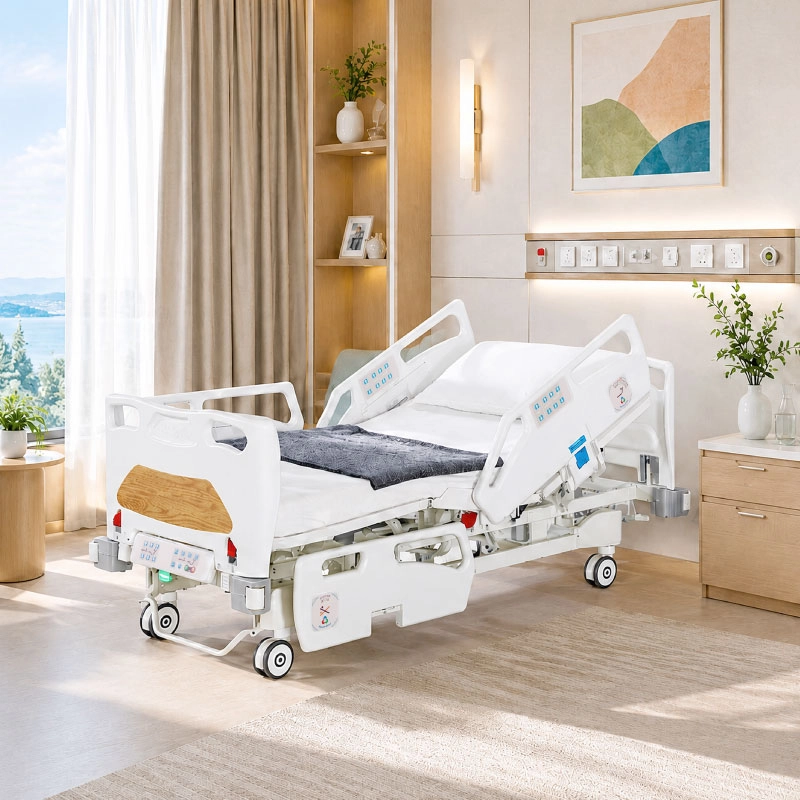
2. Featured Trendelenburg Hospital Beds: Engineering Excellence & Specifications
Joson-Care designs and manufactures a comprehensive portfolio of multi-function electric medical beds featuring precision motor-driven Trendelenburg and Reverse Trendelenburg adjustments. Every unit undergoes rigorous 30-step quality inspections and 15 dynamic safety stress tests before dispatch.
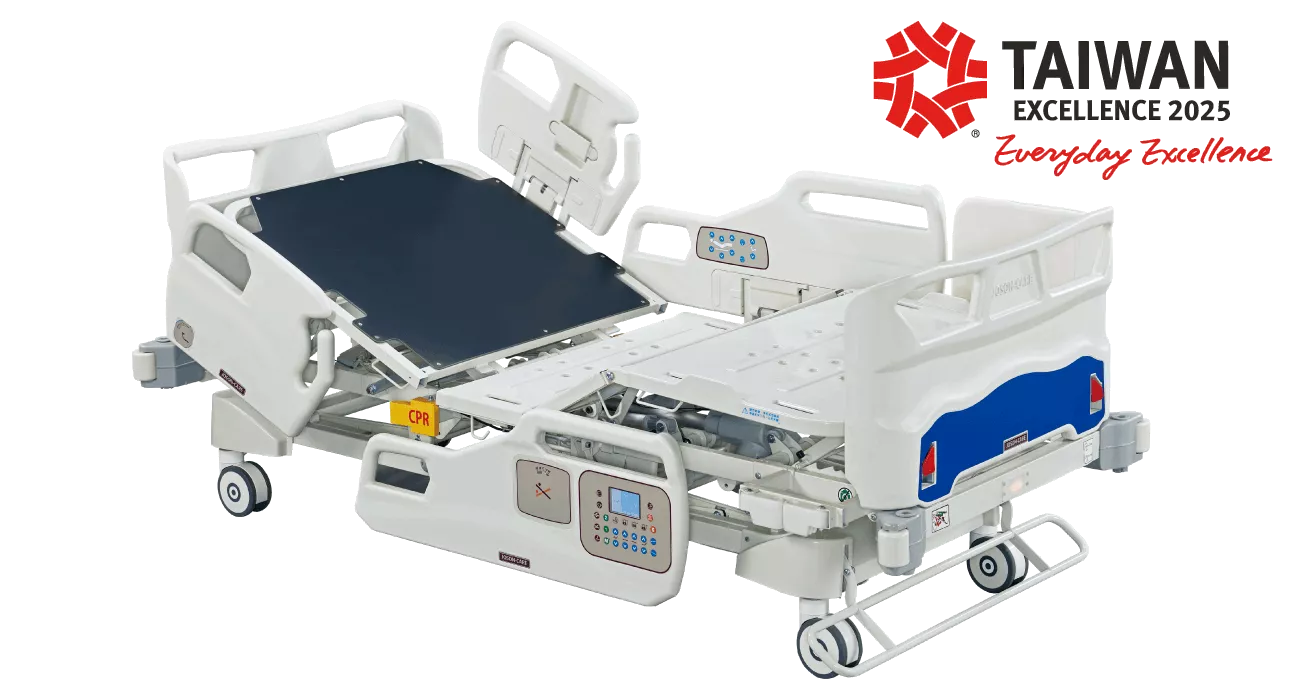
Model ES-19HD: Premium 5-Function ICU Medical Bed
Engineered specifically for high-acuity critical care environments, the flagship ES-19HD features full electric motor control for Backrest, Knee-break, Bed Height, Trendelenburg, and Reverse Trendelenburg positioning (±16° tilt range).
- Radiolucent X-Ray Deck: Fully integrated full-length X-Ray cassette slot allowing bedside radiography without patient elevation.
- Auto-Chair Functionality: One-touch synchronized articulation into a cardiac chair position to promote early mobilization.
- Bi-lateral Side-Rail Controls: Embedded nurse and patient control panels with visual angle indicators for precise backrest tilt and Trendelenburg angle verification.
- Compliance: Exceeds IEC 60601-1, IEC 60601-1-2 EMC, and IEC 60601-2-52 safety benchmarks.
Model ES-12DW: ICU Bed with Integrated Precision Weight Scale
For intensive care patients requiring accurate fluid balance monitoring alongside hemodynamic tilt adjustments, the ES-12DW combines multi-axis Trendelenburg performance with a high-precision weight sensor system integrated into the bed chassis.
- Continuous Weight Monitoring: Digital screen display at footboard showing net weight changes without moving patient cables or life-support devices.
- Advanced Safety Guardrails: Split 4-piece ergonomic side rails with zero-gap design preventing entrapment during Trendelenburg tilting.
- Battery Backup System: Built-in rechargeable power module ensuring full motorized Trendelenburg functionality during emergency transport or power outages.
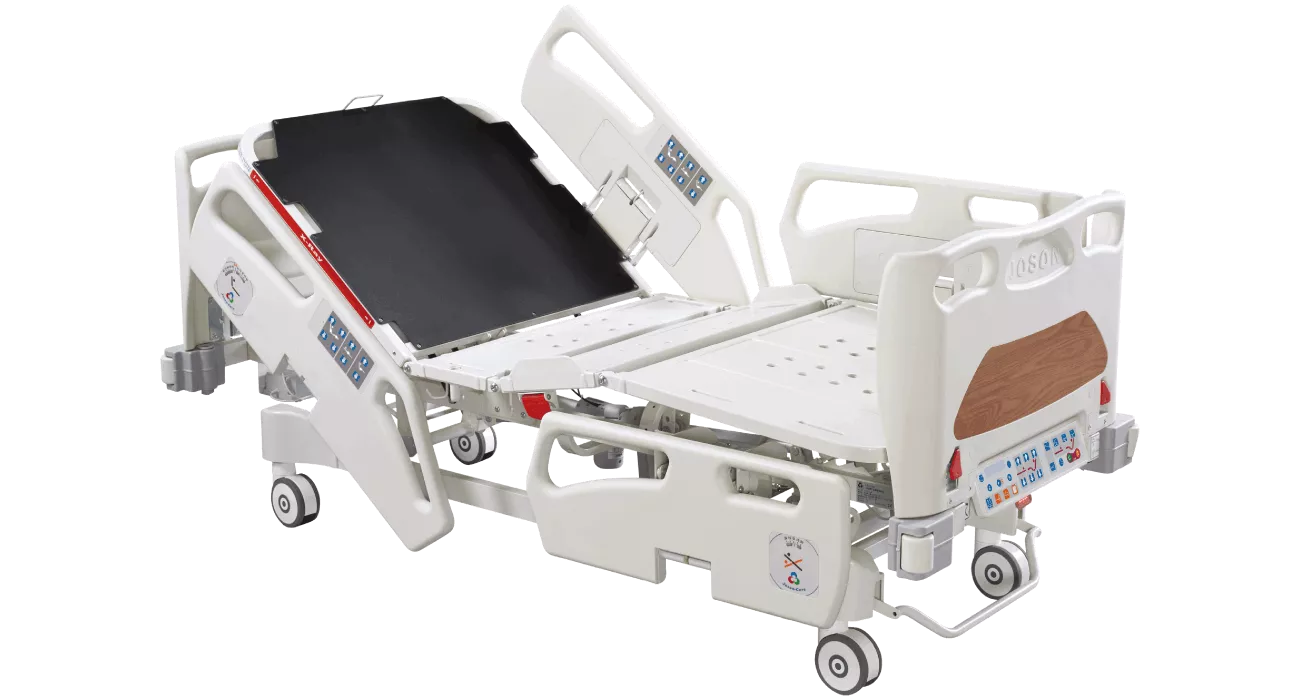
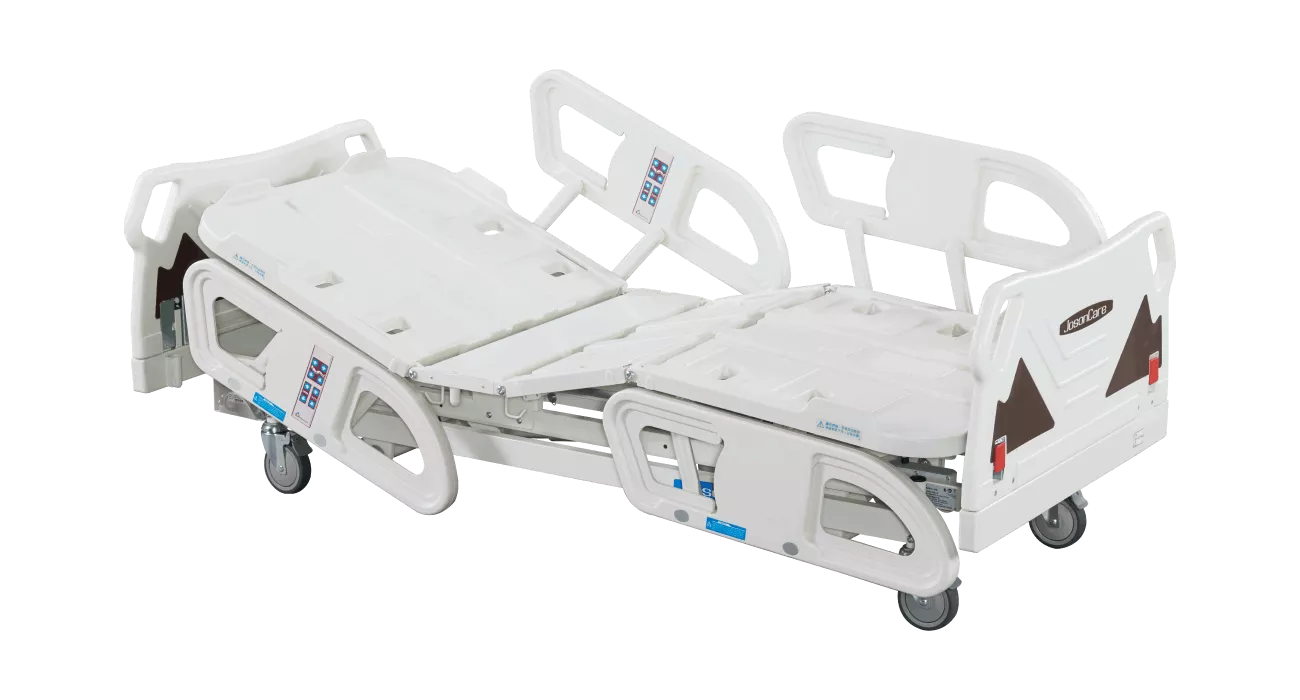
Model ES-05HDS & EN-3M: Ward & Long-Term Home Care Solutions
Extending Trendelenburg capability beyond the ICU, the ES-05HDS (100cm compact ward width) and EN-3M (Foldable Electric Home Care Bed) deliver smooth motorized Trendelenburg and Auto-chair transitions for general recovery wards and post-acute rehabilitation at home.
- Modular Guardrails: Easily customizable side-rail configurations to suit regional healthcare regulations.
- Powder-Coated Steel Chassis: High-tensile steel structural tubing treated with anti-bacterial electrostatic powder coating.
- Silent Actuator Motors: Ultra-quiet, low-voltage DC linear actuators providing gentle speed ramping during tilt adjustment to minimize patient anxiety.
Technical Matrix: Joson-Care Trendelenburg Bed Comparison
| Specification Feature | ES-19HD (ICU Flagship) | ES-12DW (ICU w/ Scale) | ES-05HDS (Compact Ward) | EN-3M (Home Care) |
|---|---|---|---|---|
| Trendelenburg / Reverse Tilt | 0° to ±16° (Electric) | 0° to ±16° (Electric) | 0° to ±12° (Electric) | 0° to ±12° (Electric) |
| Backrest & Knee-Break Articulation | 0-75° / 0-45° | 0-75° / 0-45° | 0-75° / 0-40° | 0-75° / 0-40° |
| Integrated X-Ray Deck | Full Deck Cassette Slot | Optional | N/A | N/A |
| Weight Scale Precision | N/A | ±0.1 kg Digital Display | N/A | N/A |
| Safe Working Load (SWL) | 250 kg (550 lbs) | 250 kg (550 lbs) | 220 kg (485 lbs) | 200 kg (440 lbs) |
| International Compliance | ISO 13485, CE, FDA, IEC 60601-2-52 | ISO 13485, CE, FDA, IEC 60601-2-52 | ISO 13485, CE, IEC 60601-1 | ISO 13485, CE Mark |
3. Global Procurement Trends for Trendelenburg Hospital Beds (2025–2035)
As hospital procurement teams navigate aging populations, rising ICU admission rates, and severe nursing staff shortages, the criteria for selecting medical beds are undergoing a structural shift. Modern tenders demand equipment that balances patient recovery outcomes with operational efficiency. Key global trends include:
A. Mandatory Shift Toward IEC 60601-2-52 Entrapment Prevention Standards
Regulatory bodies across Europe (MDR), North America (FDA), and East Asia are enforcing strict adherence to IEC 60601-2-52 (the specific standard for basic safety and essential performance of medical beds). Procurement tenders now disqualify beds where Trendelenburg motion creates dynamic entrapment zones between the articulating mattress platform and the head/footboards or side rails. Joson-Care's patented rail geometry maintains fixed safety clearances regardless of tilt angle.
B. Ergonomic Nurse Workload Reduction & One-Touch Mobilization
Workplace musculoskeletal injuries among nursing staff remain a major financial burden for hospital operations. Future procurement specs mandate one-touch automated positioning—such as rapid Auto-chair conversion, electronic CPR leveling within under 5 seconds, and synchronized Trendelenburg adjustments—eliminating manual crank labor and reducing caregiver fatigue.
C. Total Cost of Ownership (TCO) & Modular Maintenance Architecture
Beyond the initial FOB purchase price, healthcare hospital groups now calculate 10-year TCO. Beds engineered with modular motor control boxes, quick-connect cable harnesses, and standardized spare parts significantly reduce downtime. Joson-Care beds feature IPX4 water-ingress protected linear actuator systems and standardized control boxes, lowering long-term maintenance overhead by up to 35%.
4. Technological & Engineering Innovations in Trendelenburg Bed Design
The technological landscape of electric medical beds is evolving rapidly from basic electromechanical movement toward intelligent patient care hubs. Key technology vectors engineered into Joson-Care products include:
Dual-Actuator Linear Stability Systems
Utilizing high-torque dual linear actuators for Trendelenburg tilt guarantees smooth angle transitions under high patient load without chassis flex or mechanical shudder.
Anti-Shear & Anti-Slippage Platform Kinematics
When transitioning into steep Reverse Trendelenburg tilt, patient friction against the mattress can cause tissue shear forces leading to pressure ulcers. Joson-Care's auto-retracting backrest deck shifts backward during elevation, drastically reducing sacral shear stress.
Smart Sensor & Angle Telemetry Integration
Integrated digital tilt sensors feed angle data directly to side-rail OLED screens and central telemetry monitoring systems, alerting caregivers if therapeutic angles exceed prescribed clinical limits.
Emergency CPR Quick-Release Dampeners
Hydraulic gas-spring dampeners ensure that when emergency manual CPR levers are pulled during Trendelenburg tilt, the backrest returns to flat horizontal position safely without violent drop motion.
5. Corporate Advantages: Why Global Buyers Trust Joson-Care
Founded in 2000 in Taoyuan City, Taiwan, Joson-Care Enterprise Co., Ltd. has spent over two decades establishing a globally respected medical equipment manufacturing framework. Our commitment to strict quality control, patient-centered ergonomics, and dependable supply chain logistics has made us the preferred partner for healthcare institutions across 65+ countries.

Core Pillars of Joson-Care Manufacturing Authority:
- 25+ Years of Specialized OEM/ODM Expertise: Complete in-house R&D, precision metal stamping, robotic welding, electrostatic powder coating, and final assembly under ISO 13485 Quality Management Systems.
- Global Regulatory Compliance: Product lines fully certified to CE Mark (EU MDR ready), US FDA registration, and rigorous IEC 60601 series electrical safety standards.
- Multi-Layer Quality Assurance (30/15 Rule): Every manufactured bed undergoes 30 physical dimension and weld integrity checks, followed by 15 full-load electrical and motor duty-cycle testing runs.
- Export Infrastructure in 65+ Nations: Long-standing distribution networks throughout Europe, North America, the Middle East, Southeast Asia, and Latin America.
- Tailored B2B Customization: Complete support for tender-specific voltage requirements, custom rail profiles, branding, and specialized accessory integration (IV poles, traction frames, central braking systems).
Seeking custom OEM specifications or immediate hospital tender quotations?
Inquire Now6. B2B Procurement FAQ: Trendelenburg Hospital Bed Questions Answered
Below are technical and commercial responses to the queries most frequently presented by hospital procurement committees, biomedical engineering departments, and international medical equipment importers when evaluating Trendelenburg beds.
Partner with a Leading Trendelenburg Hospital Bed Factory
Whether you are managing a major government hospital procurement tender, equipping a new private intensive care center, or expanding your regional medical equipment distribution catalog, Joson-Care offers certified product quality and direct factory pricing.