Engineering Cortical Suspensory Fixation: Next-Generation AC Joint Repair for the Nagoya Medical Sphere
Addressing the stringent biomechanical benchmarks, regulatory expectations, and clinical demands of university hospitals, emergency critical care centers, and sports orthopedic clinics throughout Aichi Prefecture and the Chukyo Industrial Corridor.
The Biomechanical Paradigm Shift in Aichi Prefecture
Historically, orthopedic surgical departments across Nagoya University Hospital, Fujita Health University, and Nagoya City University Hospital relied extensively on rigid clavicular hook plates or trans-articular Kirschner wires for acute AC separations. However, hook plates frequently cause subacromial osteolysis, acromial impingement, rotator cuff attrition, and obligate surgeons to perform a second surgical intervention for hardware removal within 3 to 6 months.
Our Acromioclavicular Joint AC Repair Button System establishes a minimally invasive, dynamic cortical suspensory mechanism. Engineered from medical-grade Titanium Alloy (Ti-6Al-4V ELI) integrated with continuous loop Ultra-High Molecular Weight Polyethylene (UHMWPE) braided constructs, the button reconstructs the native kinematics of the coracoclavicular (CC) ligament complex (both conoid and trapezoid components). This physiological approach delivers exceptional tensile strength, mitigates tunnel widening via optimized button contact geometry, and eliminates the necessity for routine secondary extraction procedures.
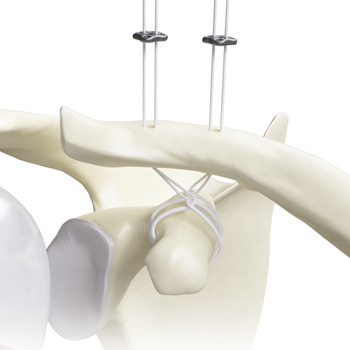
Biomechanical Integrity, Micro-Finishing, and Fatigue Endurance
Every INAR/CANWELL AC repair button is precision-manufactured under rigid ISO 13485 cleanroom conditions to fulfill rigorous international and Japanese orthopedic requirements.
Grade 23 Ti-6Al-4V ELI
Synthesized strictly from Extra Low Interstitial Titanium conforming to ISO 5832-3 and ASTM F136. Provides optimal biocompatibility, high fatigue limit, zero ferromagnetic distortion under MRI diagnostic surveillance, and minimizes bone shield stress through elastic modulus closer to native bone.
Continuous Braided UHMWPE Loop
Eliminates intraoperative knot slippage via uninterrupted multi-filament medical-grade UHMWPE fiber braid. Withstands ultimate tensile loads surpassing 1,200 N, accommodating high early physiological rehabilitation demands without mechanical creep or elongation.
Radius-Chamfered Laser Apertures
Precision electropolished eyelet contours engineered with controlled curvature radii. This completely prevents micro-fretting and abrasive shear friction between the titanium button edge and the UHMWPE suture fibers under high-frequency physiological shoulder oscillation.
| Mechanical Parameter | INAR AC Cortical Button System | Conventional Hook Plate | Synthetic Ligament Tape (PDS/LARS) | Clinical Significance in Nagoya Surgery |
|---|---|---|---|---|
| Mean Ultimate Load (N) | 1,250 ± 65 N | 850 ± 120 N | 950 ± 80 N | Withstands dynamic upward clavicular torque during overhead movement. |
| Bone Tunnel Dimension | Cannulated 3.5 mm – 4.0 mm drill | N/A (Extensive 3.5mm screws) | 5.0 mm – 6.0 mm coracoid tunnel | Significantly reduces coracoid base fracture risk during preparation. |
| Subacromial Impingement | Zero (Non-articular fixation) | High (Subacromial erosion risk) | Low | Prevents rotator cuff abrasion and post-op bursitis. |
| Secondary Hardware Removal | Not Required (Permanent fixation) | Obligatory in >95% of cases | Low (Except for foreign-body reaction) | Reduces Japan Health Insurance burden (DPC cost-containment). |
| Horizontal Stability Control | Dual-construct / AC suture augmentation | Rigid vertical only | Moderate horizontal toggle | Addresses both AP translation and CC vertical displacement. |
Localized Clinical Scenarios Across Nagoya & The Greater Tokai Region
Tailored implant mechanics aligned with distinct clinical pathology patterns observed in central Japan's tertiary emergency and sports reconstructive surgical departments.
Industrial Trauma Clusters (Chubu/Mikawa)
The massive automotive supply chain in Toyota, Okazaki, and Nagoya Port exhibits heavy industrial shoulder girdle impacts, direct acromial falls, and crush injuries. Surgeons in regional emergency centers (such as Nagoya Ekisaikai Hospital and Aichi Medical University Hospital) require rugged, rapid-deployment cortical buttons that achieve rigid immediate stabilization, allowing assembly line technicians to initiate protected pendulum exercises without fixation compromise.
Collegiate & Elite Athletic Centers
Nagoya is a prime national center for professional baseball, university rugby, and judo. High-velocity clavicular impacts in competitive athletes result in acute Rockwood Grade IV (posterior clavicle displacement through trapezius) and Grade V (severe vertical elevation). Arthroscopic button reconstruction preserves the deltotrapezial fascia, eliminates large incisions, and accelerates return-to-sport protocols for elite throwing athletes.
Aging Demographics & Osteoporotic Bone
With Japan’s super-aged society, active seniors in Nagoya increasingly sustain low-energy AC joint dislocations accompanied by distal clavicle micro-fractures. Standard cortical screws frequently risk strip-out in osteopenic clavicles. The broader footprint of our titanium top button distributes compressive stress over a larger cortical contact surface, preventing button sinking or cut-through under cyclic physiologic loading.
Key Medical & Procurement Trends Shaping Orthopedics in Japan
Navigating the clinical transitions and health economics influencing Japanese medical purchasing authorities.
1. Minimally Invasive Arthroscopic Dominance
Surgeons across Nagoya are steadily moving away from wide-open reduction towards purely arthroscopic subcoracoid visualization. Placing a cannulated 4.0mm guide wire under direct scope vision from the anterolateral portal minimizes soft-tissue stripping, lowers postoperative infection rates, and leaves minimal cosmetic scarring.
2. Anatomical Double-Bundle Reconstruction
Clinical papers published by Japanese shoulder specialists emphasize distinct biomechanical roles for the conoid (vertical constraint) and trapezoid (compression and horizontal constraint) ligaments. INAR’s twin-button configuration permits dual-tunnel anatomical placement, closely replicating native ligament orientation and eliminating residual post-op posterior joint laxity.
3. DPC Hospital Reimbursement Pressures
Under Japan’s Diagnosis Procedure Combination (DPC) flat-rate hospital payment structure, facilities must contain overall procedure costs while preventing unplanned readmissions. Suspensory buttons remove the fixed expense and bed-day occupancy of a second hardware-removal hospitalization, aligning directly with hospital financial metrics.
Zhejiang INAR Medical: 22+ Years of Precision Engineering
Complete vertical integration—from medical-grade raw bar stock to Class 100,000 aseptic cleanroom packaging—assuring uncompromised clinical reliability.
Rigorous 13-Stage QA & Cleanroom Production
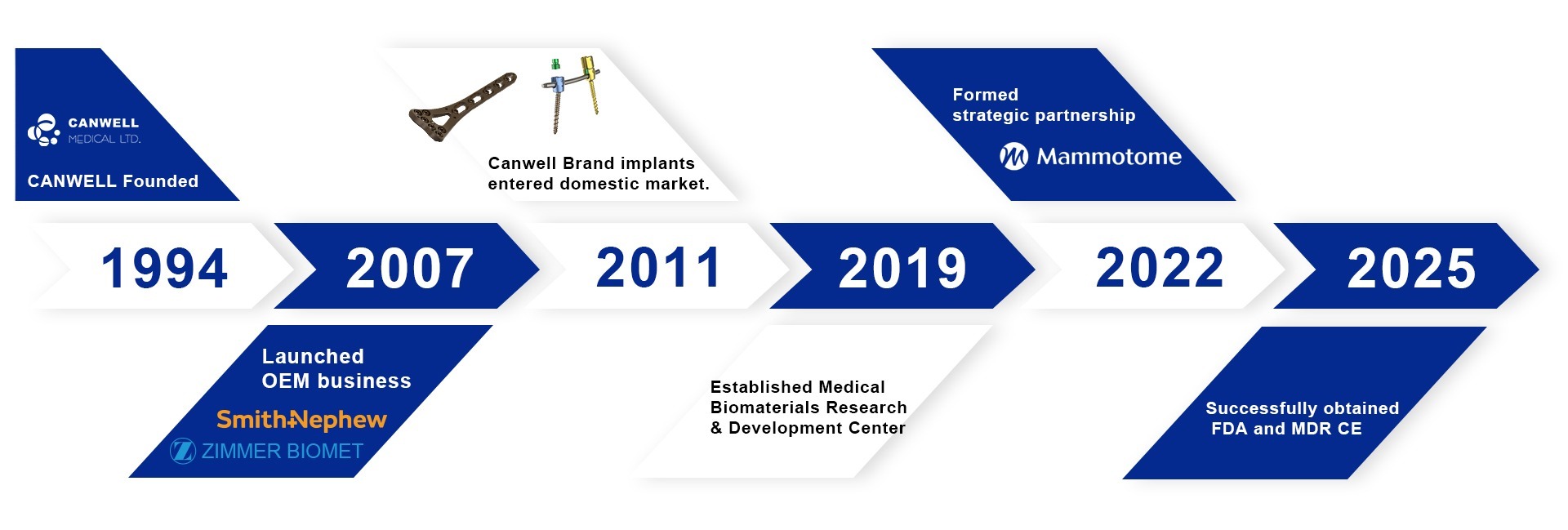
Headquartered in Jinhua, Zhejiang, Zhejiang INAR Medical Co., Ltd. (operating globally with Canwell manufacturing foundations) represents over two decades of dedicated orthopedic engineering. Employing 632 skilled team members, our manufacturing complex integrates advanced CNC longitudinal Swiss-type lathes, automated optical surface profilometers, and specialized cleanroom packaging lines.
Unlike trading intermediaries, our complete physical workflow occurs in-house. Each production batch undergoes multi-spectrum raw material verification, longitudinal profile cutting, CNC micro-milling, vibratory finishing, dual-stage ultrasonic decontamination, automated anodic oxidation color-coding, fluorescent dye penetrant testing, and 100% Outgoing Quality Control (OQC) dimensional inspection before final vacuum blister packaging.
Frequently Asked Questions for Nagoya Hospital & Distributor Buyers
Direct answers addressing Japanese medical device regulatory filings, logistics channels, customization protocols, and quality assurances.