Precision Orthopedic Implant Systems for Global Trauma & Reconstruction
Manufactured under validated cleanroom standards in Jinhua, Zhejiang, and engineered for direct integration into European trauma operating suites.
Engineering Whitepaper: The Biomechanics of One-Third Tubular Locking Plates
The one-third tubular locking plate remains an indispensable cornerstone in modern internal fixation osteosynthesis, specifically designed to address fractures in low-load, subcutaneous anatomical zones such as the distal lateral fibula, olecranon, and distal radius. As specialized Chinese manufacturers operating with SGS-audited quality management systems and CE mark approvals (under EU MDR 2017/745 and Council Directive 93/42/EEC), Zhejiang INAR Medical Co., Ltd. (CANWELL) re-engineers traditional tubular geometries into advanced locking compression platforms.
Cold-Formed Medical Grade Titanium
Fabricated exclusively from biocompatible Ti-6Al-4V ELI (ASTM F136 / ISO 5832-3) and high-purity medical Grade 4 CP-Ti. The material boasts a low modulus of elasticity (105-110 GPa) closely matching human cortical bone, thereby significantly reducing stress-shielding phenomena, accelerating callus formation, and minimizing post-operative bone resorption around the implant boundary.
Anatomical Contour & Low Profile
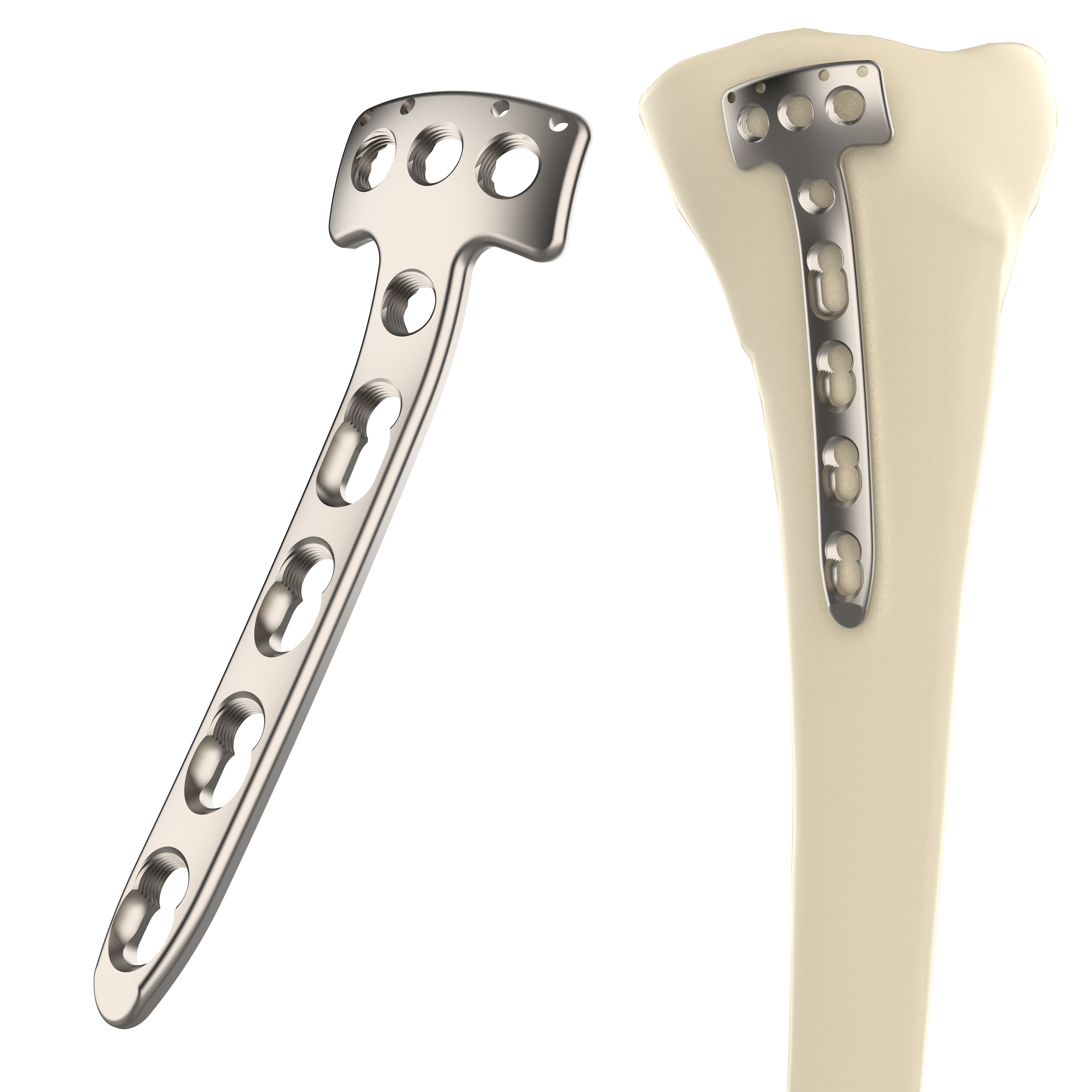
The semi-cylindrical cross-section represents exactly one-third of the circumference of an idealized bone cylinder. Engineered with tapered, rounded distal and proximal edges to facilitate submuscular insertion in Minimally Invasive Plate Osteosynthesis (MIPO). The 1.3 mm edge profile substantially decreases soft-tissue irritation, particularly critical over the lateral malleolus where skin coverage is minimal.
Hybrid Locking & Cortex Hole Architecture
Featuring precision-milled combination holes (Combi-holes) accommodating both 3.5 mm self-tapping locking screws and 3.5 mm standard cortical screws. Surgeons achieve interfragmentary dynamic compression through eccentric cortical screw placement, followed by rigid angular-stable fixation via threaded locking screws, establishing an unyielding internal fixator frame.
| Implant Parameter | CANWELL / INAR Technical Specification | Standard Market Comparison | Clinical Advantage in Traumatology |
|---|---|---|---|
| Raw Material Origin | Certified ISO 5832-3 / ASTM F136 Ti-6Al-4V ELI (Certified Lot Records) | Standard Commercial Grade Titanium / 316L | Optimal osseointegration, fatigue endurance, and MRI conditional safety |
| Plate Thickness Profile | 1.3 mm - 1.5 mm uniformly tapered; beveled ends | 1.8 mm - 2.0 mm uniform block profile | Drastic reduction in lateral skin tension; reduces hardware removal rates |
| Hole Configurations | 4, 5, 6, 7, 8, 9, 10, 12 Combi-holes (Locking + Compression) | Pure dynamic compression (DCP) or single-thread holes | Total intraoperative flexibility for buttress, bridge, or neutral fixation |
| Screw Compatibility | 3.5 mm Locking Screws (Star/Torx T15 & Hexagonal) / 3.5 mm Cortical Screws | Limited to 3.5 mm standard cortical screws only | Enhanced strip resistance and angular stability in osteoporotic bone |
| Surface Finishing | Type II Hard Anodization + Micro-Bead Blasted passivated layer | Basic acid-wash or electropolished finish | Prevents cold-welding of screwheads and enhances cyclic fatigue limits |
Localized Application Scenarios Serving Düsseldorf & Rhine-Ruhr Trauma Hubs
The urban conurbation of Düsseldorf and the wider Rhine-Ruhr metropolitan region encompass over ten million inhabitants, anchored by world-class trauma centers including the Universitätsklinikum Düsseldorf (UKD), BG Klinikum Duisburg, and municipal academic teaching hospitals across Neuss, Ratingen, and Mönchengladbach. In this densely populated industrial and sporting hub, orthopedic trauma surgeons frequently encounter acute skeletal injuries requiring reliable, anatomically adapted one-third tubular locking systems.
1. Danis-Weber Type B & C Fibular Fractures
Ankle fractures represent over 10% of all fracture presentations in North Rhine-Westphalia emergency departments, frequently linked to winter sports, regional football leagues, and industrial work accidents. In trans-syndesmotic (Danis-Weber B) and supra-syndesmotic (Danis-Weber C) patterns, the one-third tubular locking plate functions predominantly in an antiglide (posterior) or lateral neutralizing mode. When applied posteriorly, it converts destructive vertical shear forces into restorative stabilizing compression across the distal fibula.
2. Geriatric Osteoporotic Fracture Neutralization
With the shifting demographic profile in the Rhine-Ruhr valley, local geriatric trauma units (Alterstraumazentren DGU) demand implants that guarantee absolute purchase in poor bone mineral density. The angular stability supplied by INAR’s 3.5 mm locking screws prevents post-operative toggling, screw pull-out, and secondary valgus collapse, allowing immediate early post-operative mobilization and reducing pulmonary and thromboembolic complications in elderly patients.
3. Distal Ulna & Small Fragment Reconstruction
Beyond ankle fixation, trauma services across Düsseldorf deploy our pre-machined one-third tubular profiles for isolated distal ulnar shaft fractures, complex olecranon osteotomies, and lateral metacarpal fractures. The malleable yet high-tensile nature of our Grade 4 CP-Ti and Ti-6Al-4V alloys allows the surgical team to execute precise intraoperative bending without micro-fracturing the screw-hole threads.
Localization Trends: Navigating the German MDR Landscape & Purchasing Dynamics
The medical device procurement environment in Germany has undergone profound systemic changes. Healthcare institutions face severe cost containment pressures dictated by the German DRG (Diagnosis Related Groups) system, compounded by the rigorous demands of the Medical Device Regulation (EU MDR 2017/745). Hospital purchasing directors across Düsseldorf, Cologne, and Essen are transitioning away from high-overhead European brand monopolies toward audited, high-precision original equipment manufacturers in China capable of delivering regulatory-sound trauma systems.
Strict Compliance with EU MDR 2017/745
As the European transition deadlines tighten, German notified bodies (such as TÜV SÜD, TÜV Rheinland, and DEKRA) have raised technical documentation thresholds. INAR Medical maintains active CE documentation, comprehensive Clinical Evaluation Reports (CER), and systematic Post-Market Clinical Follow-up (PMCF) studies, ensuring smooth hospital acceptance without regulatory downtime.
EUDAMED & UDI Traceability Systems
German hospital procurement networks require end-to-end digital tracking. Every INAR one-third tubular plate is laser-etched with a unique Basic UDI-DI and 2D GS1 DataMatrix code. This enables automated cataloging within hospital ERP systems (SAP S/4HANA for Healthcare) and direct electronic logging in operating theaters, drastically minimizing administrative overhead.
Purchasing Consortia & Dual-Sourcing
Prominent German purchasing consortia (Einkaufsgemeinschaften like Prospitalia, Sana Kliniken Einkauf, and Clinicpartner) actively pursue strategic dual-sourcing models. By procuring trauma locking plates directly from certified Chinese manufacturers, German hospital groups mitigate supply-chain vulnerabilities while slashing Class IIb implant expenditure by up to 35-45% without sacrificing clinical efficacy.
Düsseldorf & German Procurement FAQ: Trauma Locking Plates
Clear, transparent answers addressing regulatory, clinical, and logistical considerations for German distributors and hospital procurement teams.
Are your One-Third Tubular Locking Plates fully compliant with the European Medical Device Regulation (EU MDR 2017/745)?
What raw titanium grade is utilized, and can test material certificates be provided?
How do you manage freight logistics and customs clearance for shipments entering Düsseldorf?
Can our surgical brand customize screwhead drive types and anodization color coding?
Are the plates compatible with existing AO-standard instrumentation sets used in German ORs?
What is the Minimum Order Quantity (MOQ) for hospitals or private distributors in North Rhine-Westphalia?
How do you guarantee aseptic safety and packaging validation?
Enterprise Manufacturing Infrastructure: Zhejiang INAR Medical Co., Ltd.
With over two decades of dedicated specialization in the orthopedic implant manufacturing sector, Zhejiang INAR Medical Co., Ltd. has evolved into an integrated technological hub encompassing 29,523 square meters of state-of-the-art production floorspace in Jinhua, Zhejiang. Our 632-strong workforce combines veteran biomedical tooling engineers, CNC machining artisans, regulatory compliance directors, and clinical research specialists.
High-Precision CNC Machining Centers
Our facility operates multi-axis high-speed CNC machining centers, sliding-head Swiss lathes (Citizen, Star), and longitudinal cutting stations capable of maintaining dimensional tolerances within ±0.005 mm. This micron-level precision ensures zero binding of locking screw heads, flawless pitch continuity, and pristine surface finishes across complex tubular curvatures.
Rigorous 13-Stage Quality Control Route
No component departs our facility without traversing a documented 13-station manufacturing and testing chain. This encompasses raw material spectral analysis, longitudinal profile cutting, precision multi-axis milling, edge deburring, dual-stage ultrasonic wash cycles, liquid penetrant crack inspection per ASTM E1417, controlled anodization, laser verification, and 100% optical outgoing quality control (OQC).
In-House Mechanical Testing Laboratory
We validate long-term implant endurance through dedicated fatigue testers and torque analyzers complying with ASTM F382 (Standard Specification and Test Method for Metallic Bone Plates). Dynamic four-point bending tests guarantee that our one-third tubular plates withstand over one million loading cycles without structural micro-fissuring or yield deformation.