Featured Orthopaedic Implants & Instrument Assemblies
Machined under rigid cleanroom protocols and exported to regional surgical centers worldwide. Fully matched with CE-certified instrument trays and sterile protective transit packaging.
White Paper: Engineering Architecture of Polyaxial Pedicle Screws for Complex Spinal Reconstruction in Emerging Surgical Corridors
Spinal stabilization within tertiary regional hospitals requires robust biomechanical reliability, streamlined intraoperative articulation, and flawless fatigue life under cyclic loads. In rapidly modernizing healthcare nodes such as Suai—the strategic commercial capital of the Cova Lima Municipality in southwestern Timor-Leste—the clinical landscape presents unique operational demands. Orthopaedic surgeons and clinical procurement directors face an escalating burden of traumatic spinal fracture-dislocations resulting from high-energy road transit across rugged terrain, coupled with severe degenerative degenerative spondylolisthesis, thoracic kyphosis, and spinal tuberculosis (Pott's disease).
As an SGS-verified orthopaedic implant and precision instrument manufacturing enterprise with over 22 years of continuous clinical engineering experience, Zhejiang INAR Medical Co., Ltd. (CANWELL Medical) operates as a primary factory supplier to surgical distributors, ministries of health, and institutional healthcare supply chains across the Asia-Pacific region. Our polyaxial pedicle screw systems are synthesized to surpass international regulatory directives, bridging the critical gap between ultra-fine CNC Swiss micro-machining and field-proven clinical utility.
All polyaxial pedicle screws manufactured at our Jinhua facility undergo stringent cyclic dynamic compression-bending fatigue evaluations, torsion resistance testing, and axial pull-out force assessments in validated polyurethane foam test blocks (ASTM F1839). With endurance limits consistently exceeding five million load cycles without catastrophic yield, our systems guarantee immediate multi-column structural stability in challenging osteoporotic and high-stress trauma patient profiles.
Biomechanical Design Dynamics & Metallurgy of CANWELL Polyaxial Pedicle Screws
The polyaxial pedicle screw serves as the anchor point of posterior spine stabilization. Unlike monoaxial screws that dictate rigid, planar trajectory angles—imposing unnecessary cantilever loads onto vertebral anatomy—polyaxial screws feature an articulated spherical head housed within an ergonomic, low-profile tulip housing. This configuration permits an expansive cone of angulation exceeding 45° to 60°, eliminating forced contouring of connecting titanium rods and preserving the integrity of facet joints.
Our manufacturing process relies exclusively on certified implant-grade titanium alloy conforming to ASTM F136 (Ti-6Al-4V ELI - Extra Low Interstitial). This alloy provides superior biocompatibility, heightened tensile strength (>860 MPa), and an elastic modulus significantly closer to cortical bone than traditional 316L medical stainless steel. This elasticity differential mitigates stress shielding at the bone-screw interface, fostering rapid osteointegration and markedly decreasing the risk of postoperative screw loosening, pull-out, or pseudarthrosis.
Dual-Core Thread Profiling
Engineered with a cortical thread pitch proximally and an aggressive cancellous thread profile distally. This dual-lead thread geometry doubles screw insertion speed while amplifying bone-to-thread contact area, resulting in up to 34% higher pull-out resistance in low-density trabecular bone.
Zero-Back-Out Reverse Buttress
The internal tulip threads feature an advanced negative-angle reverse buttress design. When tightened using our calibrated torque-limiting ratchets (typically set at 10.0–12.0 N·m), cross-threading is completely prevented, and lateral tulip splaying is eliminated, permanently locking 5.5mm/6.0mm rods.
Micro-Textured Ball Saddle
The internal spherical head of the screw incorporates high-friction microscopic blast texturing. Upon torque application, the set screw drives the rod onto the crown saddle, imparting intense localized clamping pressure that guarantees exceptional torsional and angular locking strength under dynamic flexion.
Localized Surgical Application Scenarios in Suai & Regional Healthcare Infrastructure
Suai holds an essential geopolitical and economic status in Timor-Leste. As the administrative capital of Cova Lima and the designated terminus of the modern South Coast Highway corridor (linking Suai, Betano, and Beaço), the region experiences severe logistical challenges alongside rapid civic growth. While primary community clinics handle routine cases, complex orthopaedic trauma is directed to the Hospital Regional de Suai or stabilized for secondary transfer north over rugged mountain passes to the Hospital Nacional Guido Valadares (HNGV) in Dili.
The development of petroleum infrastructure around the Suai Supply Base combined with heavy vehicle logistics and domestic motorcycle traffic yields frequent unstable burst fractures of the thoracolumbar junction (T11–L2). CANWELL polyaxial screws allow emergency trauma surgical teams to achieve immediate multi-segment bridging, decompression, and sagittal balance restoration, halting secondary neural deficit during critical patient transit.
The vast majority of the Cova Lima workforce engages in subsistence farming, palm harvesting, and heavy manual timber operations. Chronic, late-presenting lumbar canal stenosis, multi-level disc prolapse, and degenerative spondylolisthesis are pervasive. Our low-profile polyaxial screws minimize surrounding paraspinal muscle devascularization, reducing operative blood loss and postoperative pain in resource-limited rural theatres.
Endemic pulmonary and osteoarticular tuberculosis remains an acute regional public health concern in the Timor Sea coastal plains. When vertebral collapse from Pott's disease creates severe focal kyphosis, long-segment posterior fixation using polyaxial pedicle screws provides the rigid stability required for anterior debridement, strut grafting, and aggressive targeted antibiotic recovery.
In hot and humid tropical operating environments where reducing surgical incision surface area directly lowers hospital-acquired surgical site infection (SSI) rates, our cannulated, long-arm polyaxial screws permit percutaneous pedicle cannulation under fluoroscopic guidance, slashing skin closure duration and shortening patient hospital stays.
Localized Healthcare Development Trends Across Timor-Leste & Cova Lima
The healthcare sector of Timor-Leste is traversing a decisive period of structural decentralization. Under strategic guidelines issued by the Ministério da Saúde (MoS), reliance on overseas medical evacuation to Darwin, Denpasar, or Singapore is being systematically reduced in favor of cultivating internal surgical autonomy. Over the next decade, three key procurement and clinical trends will redefine the demand for spinal implants in Suai:
1. Expansion of Secondary and Tertiary Surgical Capabilities: Investment in modern diagnostic imaging—such as fixed computed tomography (CT) scanners and mobile C-arm fluoroscopy units at regional referral centers—is unlocking posterior pedicle screw fixation procedures previously confined entirely to Dili. As regional theatre teams gain instrumentation proficiency, supply chains must deliver dependable implant stock with zero margin for machining failure.
2. Rigorous Transition Away from Unregulated Gray-Market Implants: Public procurement divisions and private hospital consortiums in Southeast Asia are aggressively phasing out uncertified implants. Sourcing now mandates documented compliance with international norms: European CE certification (EU MDR 2017/745 / 93/42/EEC), ISO 13485:2016 Quality Management Systems, and third-party facility audits conducted by globally recognized bodies such as SGS Group.
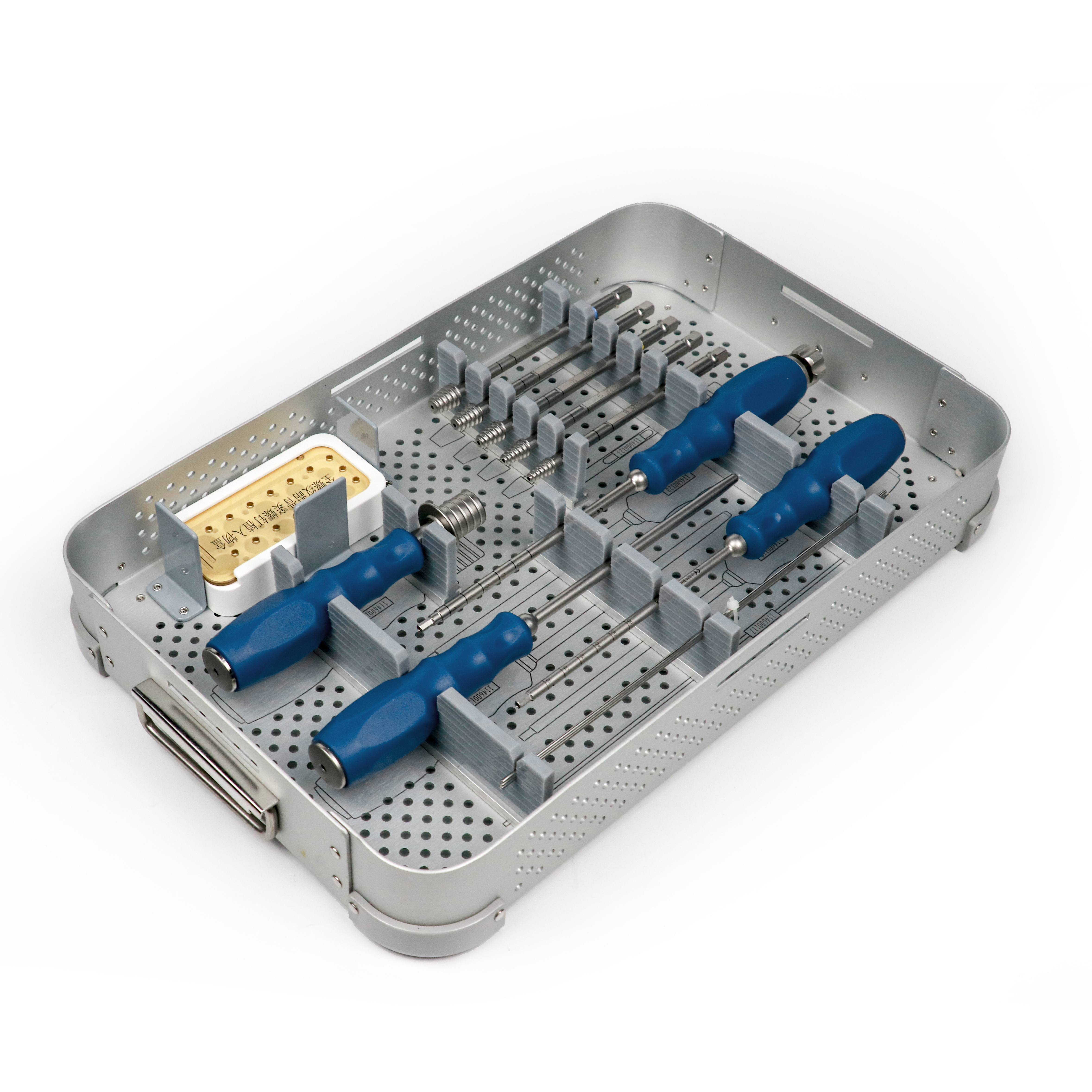
3. Demands for Turnkey Consignment & Autoclave-Stable Instrument Trays: Surgical teams in regional operating environments cannot accommodate missing screw lengths or broken quick-coupling screwdrivers mid-procedure. B2B distributors in Suai require consolidated sterilization cassettes crafted from aerospace-grade anodized aluminum and PPSU (polyphenylsulfone) that withstand repetitive steam autoclave sterilization cycles (134°C at 2.2 bar) without degradation.
Comprehensive Engineering Specifications: CANWELL Polyaxial Pedicle Screw System
Procurement teams and biomedical hospital engineers can review the exact metallurgical and mechanical specifications of our spinal portfolio below:
| Technical Parameter | Standard Polyaxial Screw | Cannulated MIS Polyaxial Screw | Fenestrated Cement-Augmented Screw |
|---|---|---|---|
| Raw Material Standard | ASTM F136 Ti-6Al-4V ELI | ASTM F136 Ti-6Al-4V ELI | ASTM F136 Ti-6Al-4V ELI |
| Available Diameters (mm) | Ø4.5, Ø5.0, Ø5.5, Ø6.0, Ø6.5, Ø7.0 | Ø5.5, Ø6.0, Ø6.5, Ø7.0, Ø7.5 | Ø6.0, Ø6.5, Ø7.0, Ø7.5, Ø8.0 |
| Length Increments (mm) | 25mm to 60mm (5mm increments) | 35mm to 60mm (5mm increments) | 35mm to 60mm (5mm increments) |
| Polyaxial Articulation Range | ±30° cone (60° total excursion) | ±28° cone (56° total excursion) | ±26° cone (52° total excursion) |
| Connecting Rod Compatibility | Ø5.5 mm / Ø6.0 mm (Titanium / CoCr) | Ø5.5 mm / Ø6.0 mm (Titanium / CoCr) | Ø5.5 mm / Ø6.0 mm (Titanium / CoCr) |
| Set Screw Drive Mechanism | Torx T25 / Hexagonal Antitheft | Torx T25 Low-Profile | Torx T25 High-Torque |
| Surface Passivation & Coating | Electrolytic Anodized Type II | Electrolytic Anodized Type II | Electrolytic Anodized Type II |
| Sterility & Packaging | Non-Sterile Kit / Sterile Blister | Double Tyvek® Sterile Packaging | Double Tyvek® Sterile Packaging |
Enterprise Manufacturing Capabilities: Why Global Distributors Partner With INAR
Founded over two decades ago, Zhejiang INAR Medical Co., Ltd. has grown to encompass 632 dedicated employees operating across an expansive 29,523-square-meter advanced manufacturing facility in Jinhua, Zhejiang, China. Unlike conventional trading intermediaries, every spinal implant bearing the CANWELL brand is completely manufactured, finished, inspected, cleaned, and packed in-house under strict laminar flow cleanrooms.
Our manufacturing ecosystem features five-axis CNC machining centers imported from Switzerland and Japan, ensuring dimensional tolerances within ±0.005 millimeters. Every batch of polyaxial screws passes through our standardized 13-stage manufacturing process, which includes dual ultrasonic decontamination stages, precision surface bead blasting, anodized color-coding by diameter, and 100% fluorescent dye-penetrant surface defect examinations to eliminate micro-fractures prior to dispatch.
Procurement & Clinical FAQs for Buyers in Suai & Timor-Leste
Here are detailed responses to the most critical technical, commercial, and regulatory inquiries submitted by hospital purchasing committees, health authorities, and B2B medical equipment distributors: